Romans, Reformation Artists, and Willamette: The Travels of an Early Christian Text into the Hatfield Library Vault

By Doreen Simonsen
Humanities & Fine Arts Librarian, dsimonse@willamette.edu

Hans Holbein, Basel, 1521

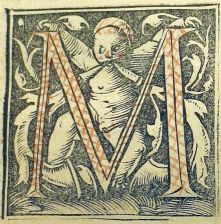
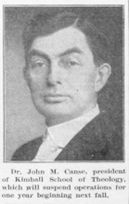
any people have been involved with the creation, printing, illustrating, selling, and purchasing of this particular book over the centuries. The most recent owner this book was Dr. John M. Canse, President of the Kimball School of Theology, a part of Willamette University from 1906 to 1930.  The book is called L. Coelii Lactantii Firmiani Diuinarum institutionum libri VII or The Divine Institutes, and the large initial M on the left is one of the illustrations by Hans Holbein the Younger inside this book.   “Printed entirely in Latin…it shows the struggle between the ideas of Paganism and those of Christianity… and in 1926, Dr. J. M. Hitt, State Librarian of Washington State considered it to be the oldest book from moveable type found in the Northwest at that time.” 1

John M. Canse
Collegian 19303

On June 17, 1953, Dr. Canse gave this book to Willamette University, and inscribed it with the following:

“This author was the silver-tongued Christian of the 4th century.  This copy came from a German Monastery to Fort Wayne, Ind. Where I secured it in 1906.  Perhaps the oldest book in Moveable type in the Northwest.”2

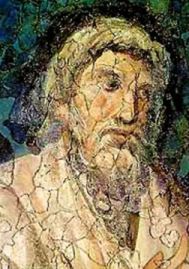
Lactantius, 4th cent. 4

This silver-tongued Christian was Lactantius, who was born a citizen of the Roman Empire circa 250 C.E. in the northern African town of Cirta, where he taught Latin. Emperor Diocletian summoned him to his court in Nicomedia in Asia Minor (present day Turkey) to teach Latin Rhetoric to administrators of his empire.  As a courtier, Lactantius met another follower of the Roman (Pagan) religion, the future emperor Constantine.  Both eventually converted to Christianity, and Lactantius fled the region during Emperor Diocletian’s Great Persecution of Christians in 303 C.E.

While in exile, Lactantius wrote this work, The Divine Institutes, “a treatise which sought to commend the truth of Christianity to men of letters and thereby for the first time set out in Latin a systematic account of the Christian attitude to life.”5 “It is the earliest systematic account of Christian morality in Latin.” 6 His written command of the rhetoric of classical texts and “pagan” mythology created a rational argument for Christianity that led him to be called the Christian Cicero.  Later he was also called a Christian Humanist and was widely read and published during the Renaissance.

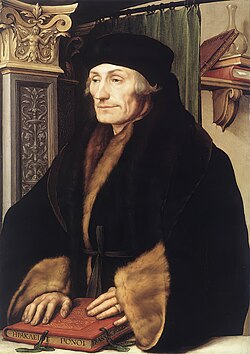
Eramus by Holbein 1523 7

The Dutch philosopher, Erasmus, was one of the many 15th and 16th century Humanistic authors who published an edition of Lactantius’ Divine Institutes.  In 1521, the year that our copy of this book was published, Erasmus had settled in Basel, Switzerland, where he befriended the young artist, Hans Holbein the Younger, who painted this famous portrait of him. Erasmus introduced Holbein to his friend, Sir Thomas Moore of England, whose portrait he also painted, and through his connection with Moore, Holbein became the court artist of the Tudors, especially Henry VIII.

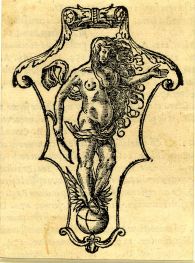
Cratander’s Printer’s Mark
by Holbein, 1525 9

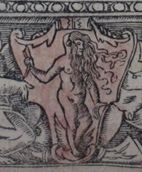
However, while living in Basel, Holbein also created designs for several woodcuts used by printers in that city,8 including Andreas Cratander, who printed our book in 1521.  Besides the beautiful title page, Holbein designed Cratander’s Printer’s Mark.  An earlier version can be seen  on the bottom of the title page of our 1521 book, and the 1525 version is included the images of Printers’ Marks on the ceiling of the West Corridor. Library of Congress Thomas

Occasio, 1521 10

Jefferson Building.11  “Cratander repeatedly used as his mark the figure of Occasio, or Opportunity. Bald at the back, her hair blown before her, with winged feet she strides the world; in her hand she carries a razor to show how sharply is divided the fleeting present from the irrevocable past.”12

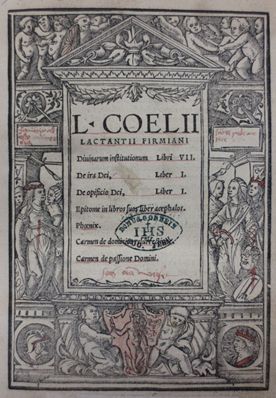
Holbein, Title-Border, 1521 13


Basel was a major center for Renaissance Humanist and later Protestant publishing during the Reformation. On the title page, Holbein includes putti (cherubs) at the top and the bottom of the page, a classical Italianate frame around the text, and the images of two women on each side.  On the left is Lucretia, a noblewoman of Ancient Rome, who committed suicide by stabbing herself under her breast after being raped by Tarquin, the king’s son.  The other woman is Judith, a Israelite widow who beheads Holofernes, an Assyrian general, in order to protect her city.  At the bottom are two more putti holding the printer’s mark of Cratander between two Roman medaillons in bottom corners. Cratander also used this same title page border later that year for a work by Johannes Oecolampadius, a German Protestant reformer, for whom he continued to publish Protestant works for several years.14

On top of the text of the title page is a stamp from the book’s next known destination, the Jesuit Monastery of Gorheim, in Sigmaringen, Southern Germany, which was in operation from 1852 – 1872. 15 

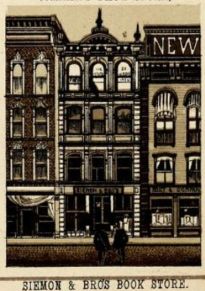
Simeon & Brother
Bookstore, 1888. 16

This may be where the booksellers Simeon & Brother at 714 Calhoun Street in Fort Wayne, Indiana found and purchased our book. They were noted vendors of German and Theology books.17  And they were also listed in the International Adressbuch des Deutschen Buchhandels (Addressbook of German Bookstores) as the only only German bookstore in Fort Wayne, Indiana in 1905.18 This is where Dr. Canse must have found and purchased this book in 1906. 

Born in Orland, Indiana in 1869, Dr. Canse graduated with the class of 1899, at DePauw University (a Methodist University) in Greencastle, Indiana, where he later earned his Doctorate in Divinity in 1918. In 1907 he moved from Fort Wayne to the Pacific Northwest, where he served as a minister to several places in Oregon and Washington.  He researched the early Methodists in the region and was also active in the Washington State Historical Society.  In 1926 he was offered the position of President of Kimball School of Theology by Willamette University’s Board of Trustees, and he held this position until the school closed in 1930. 19  “He gave considerable attention to original research on the Indian Mission Period of Old Oregon.  A text entitled, “Missionary Colonizers of the Pacific Northwest,” was written.  It appeared first in the Pacific Christian Advocate,”20 a newspaper founded in 1859 in Salem, Oregon by Alvan Waller, one of the founders of Willamette University.

Canse’s biography of
Jason Lee, 1930 21

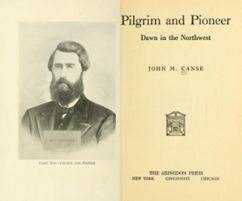
In 1930 Canse published a biography of Jason Lee called Pilgrim and Pioneer: Dawn in the Northwest. His book includes chapters on “Red Tribes Seek the White Man’s Secret of Success, Indian Camp Meetings and War Clouds, and Indian Missions Fade into White Churches.” In 1932 a reviewer noted that work was “uncritical of Lee…Its chief value, and this is important, is its emphasis upon the religious devotion and zeal that animated Lee’s work.”22

The terror of Diocletian’s Great Persecution of Christians in 303 C.E. forced Lactantius to flee Nicomedia and inspired him to write his arguments in favor of Christianity for educated Latin readers of the 4th century. The printing whirlwind of 16th century Basel produced religious tracts at the beginning of the Reformation, including our book which ended up at a Jesuit monastery in Germany. An American bookseller found it there and added it to his inventory in Indiana, where it fell into the hands of a scholar who celebrated the colonizing of the Northwest by Methodist missionaries. This text has traveled through centuries of religious convictions, conflict, and conversions. If you would like to see this book for yourself, please contact Doreen Simonsen, dsimonse@willamette.edu to make an appointment.

Endnotes:

1. “The Oldest Book of Northwest is Possession of Doctor Canse.” The Willamette Collegian. Vol. VI, No. 7, April 1895, p. 1.

2. Lactantius, Markos Mousouros, Andreas Cratander, and Venantius Honorius Clementianus Fortunatus. L. Coelii Lactantii Firmiani Diuinarum institutionum libri VII … Basileae: apud Andream Cratandrum, 1521. Mark O. Hatfield Library. https://orbiscascade-willamette.primo.exlibrisgroup.com/permalink/01ALLIANCE_WU/2i92kk/alma9930454435201454

3. “Kimball to Close during 1930-31.” The Willamette Collegian. Vol. XLI, No. 18, February 20, 1930, p. 1.

4. “Fourth-century mural possibly depicting Lactantius (also possibly Apuleius).  https://commons.wikimedia.org/wiki/File:Lactantius.jpg

5. Edwards, Mark. “Lactantius.” In The Oxford Dictionary of the Christian Church. : Oxford University Press, 2022. https://www.oxfordreference.com/view/10.1093/acref/9780199642465.001.0001/acref-9780199642465-e-4053.

6. Baldwin, Barry. “Lactantius.” In The Oxford Dictionary of Byzantium. : Oxford University Press, 1991. https://www.oxfordreference.com/view/10.1093/acref/9780195046526.001.0001/acref-9780195046526-e-2984.

7. Hans Holbein the Younger (German, 1497/8 – 1543), Erasmus, 1523oil on wood, 73.6 × 51.4 cm.  The National Gallery, London. https://commons.wikimedia.org/wiki/File:Holbein-erasmus.jpg

8. Schmid, Heinrich Alfred. “Holbeins Thätigkeit für die Baseler Verleger.” Jahrbuch der Königlich Preussischen Kunstsammlungen 20 (1899): 233–62. http://www.jstor.org/stable/25167403.

9. Hans Holbein the Younger (German, 1497/8 – 1543), Printer’s Mark of Andreas Cratander, 1525, Metalcut print on paper, 85 × 59 mm.  The British Museum, London. © The Trustees of the British Museum. Shared under a Creative Commons Attribution-NonCommercial-ShareAlike 4.0 International (CC BY-NC-SA 4.0) licence.

10. Lactantius, Markos Mousouros, Andreas Cratander, and Venantius Honorius Clementianus Fortunatus. L. Coelii Lactantii Firmiani Diuinarum institutionum libri VII … Basileae: apud Andream Cratandrum, 1521.

11. Highsmith, Carol M, Photographer. Second Floor Corridor. Printers’ marks+Columns. Printer’s mark of Cratander in West Corridor. Library of Congress Thomas Jefferson Building, Washington, D.C. , 2007. Photograph. https://www.loc.gov/item/2007684459/.

12. Willoughby, Edwin Eliott. “The Cover Design.” The Library Quarterly: Information, Community, Policy 21, no. 2 (1951): 127–127. http://www.jstor.org/stable/4303991.

13. Hans Holbein the Younger (German, 1497/8 – 1543), Title-Border with Judith and Lucretia, 1521, Metalcut print on paper, 174 × 121 mm.  The British Museum, London. © The Trustees of the British Museum. Shared under a Creative Commons Attribution-NonCommercial-ShareAlike 4.0 International (CC BY-NC-SA 4.0) licence.

14.  Colombo, Matteo, Benjamin Manig, and Noemi Schürmann. 2024. “A Reformation in Progress: The Path toward the Reform of Johannes Oecolampadius” Religions 15, no. 9: 1147. https://doi.org/10.3390/rel15091147

15. “Kloster Gorheim.” https://de.wikipedia.org/wiki/Kloster_Gorheim

16. “Simeon & Bros. Bookstore.” Souvenir of Fort Wayne, Indiana. 1888, page 12.  https://archive.org/details/souveniroffortwa00fort/page/n11/mode/2up

17. “Simeon & Brother.” The Bookmart: A Monthly Magazine of Literary and Library Intelligence, Vol.2, No. 4, September 1, 1884, page 391. https://books.google.com/books?id=Z1ADAAAAYAAJ&pg=PA391&dq=Siemon+%26+Brother.+Booksellers+Wayne&hl=en&newbks=1&newbks_redir=0&sa=X&ved=2ahUKEwi_lp225aL7AhWlCTQIHRQ5AEQQ6AF6BAgDEAI#v=onepage&q&f=false

18. “Fort Wayne (Indiana).” Adressbuch des Deutschen Buchhandels.  1905, V. Abteilung, Seite. 378. https://babel.hathitrust.org/cgi/pt?id=hvd.32044092543537&seq=940&q1=amerika&view=1up

19. John Canse Papers, 1884-1958.  Finding Aid. https://wshs-collections.s3.us-west-2.amazonaws.com/Ms%20148%20Finding%20Aid.pdf

20.“Kimball Policy Yet Uncertain: President Canse Here: Newly Elected Administrator is Well Known Figure in Northwest Circles.” The Willamette Collegian. Vol. XXXiX, No. 1, September 29, 1926, p. 1.

21. Canse, John M. Pilgrim and Pioneer : Dawn in the Northwest. New York ; The Abingdon Press, 1930. https://archive.org/details/pilgrimpioneerda01cans/mode/2up

22. R. C. Clark, Pilgrim and Pioneer: Dawn in the Northwest. By John M. Canse and Jason Lee: Prophet of New Oregon. By Cornelius J. Brosnan, Journal of American History, Volume 19, Issue 3, December 1932, Pages 447–448, https://doi.org/10.2307/1892791


Summer Fun

person reading outdoors by waterSummer often gives people more time to relax, rejuvenate, and, of course, read!  Without the pressure of school and deadlines, reading can become a more leisurely, enjoyable activity.  Readers can explore different worlds, enjoy a light “summer read” or a breathtaking thriller, and temporarily forget about their day-to-day life.  For the travelers among us, books are wonderful company on those long plane, train, or automobile rides.  The warmer weather and less likelihood of a sudden rainstorm, makes outdoor reading more feasible—there is something magical about reading while sitting on the beach or a park bench with the sun shining, the birds singing, and a gently breeze blowing…


The longer days of summer offer us the chance to tackle that long list of books we’ve been meaning to read, explore different perspectives, and learn something new. No matter what your plans are for the summer, a good book is a perfect companion. To get you started on your reading adventures, check out these summer-related titles available from the library’s collection on the WU Reads Reading Guide.


“There is a temperate zone in the mind, between luxurious indolence and exacting work; and it is to this region, just between laziness and labor, that summer reading belongs.” — Henry Ward Beecher


Psychedelic Pop Art and Pliés

By: Sarah Samala, ‘28

When you think of ballet, what comes to your mind? For most, it’s pink tights, pale tutus and classical music. However, when I was going through the materials donated by visual artist Tom Cramer in the Pacific Northwest Artists Archive, I came across the bright, almost psychedelic backdrops and hand-painted costumes of Oregon Ballet Theatre’s Jungle. Seeing Cramer’s strange, pop-art-esque art that typically covered cars or carved wood totems adorn the bodies and stage of the Oregon Ballet Theatre brought to mind several questions. Why was Tom Cramer chosen to set and costume a ballet? What was Jungle about? And finally, how did Cramer’s sets play into its narrative? Through research and the wealth of papers in the Willamette University Archives, I discovered the history of Jungle, and why Tom Cramer’s art was essential to its role within the modern dance world.

Jungle dancers stand in a line in front of Cramer’s set (TomCramerArt).

Tom Cramer was born in 1960 in Portland Oregon. He earned his BFA at the Museum Art School, now known as the Pacific Northwest College of Art in 1982. Cramer often combined different cultural mediums in his art. His early work, which consisted of abstract art and hand-carved totems, took inspiration from a variety of techniques like traditional Native American wood-carving and German expressionism. Cramer’s bright and chaotic style even made it onto unconventional canvases, as evidenced by his painted Volkswagens. Tom Cramer’s art was loud and memorable, yet described as eerily dark and foreboding by many. It was these qualities that caught the eye of dance agent Alex Dubay, who reached out to the Oregon Ballet Theatre’s artistic director, James Canfield, and pushed the visual artist into the world of ballet and theatre.

The Oregon Ballet Theatre first featured Cramer’s work in the 1994/95 season, where his first ever ballet set debuted in the American Choreographer’s showcase. The showcase was a culmination of several young choreographer’s original works, meant to challenge choreographers and dancers alike through its experimental nature. Shortly after being imbursed for this initial commission, Canfield sought out Cramer for another piece, one that would become one of Canfield’s most well-known works.

Tom Cramer and the set for the Fifth American Choreographer’s Showcase (Box 3, Folder 2).

The 1996/97 season’s “James Canfield Signatures,” featured Jungle, a fast-paced piece meant to capture the violence and majesty of animal life. Unlike most productions, Jungle’s set, which was a thirty-by-sixty-feet mural that channeled the essence of nature in Cramer’s style, was actually created before the choreography. This unconventional choice challenged choreographers to mold their work around the energy of Cramer’s art, making it the foundation of the entire piece. The music used within Jungle was also an unusual choice; forms I, II, III and IV from Future Sound of London’s Lifeforms, uses ambient electronic sounds to mimic the bird and insect sounds of nature rather than carry the audience to a dramatic or climatic ending. The costumes reflect this unorthodox theme as well, instead of tailoring costumes to each dancer, Cramer painted a large piece of nylon in his colorful abstract style that was cut and sewn into the dancer’s outfits, meaning each costume carried a piece of the larger artwork. Some costumes were even painted directly onto the bodysuits while they were on the dancers.

Tom Cramer paints a large strip of nylon that will be cut and sewn into Jungle’s costumes (Box
3, Folder 2).

Aside from the American Choreographer’s Showcase, Jungle and its accompanying James Canfield Signatures were a modern first for the company, which typically produced traditional shows such as The Nutcracker and Romeo and Juliet. Similar to Cramer’s innovative method of combining different mediums, artistic director Canfield wanted Jungle to change the expectations of a “standard” ballet by merging the traditional art form with unconventional practices and abstract art. Throughout his work in the Oregon Ballet Theatre, Canfield strived to “carry ballet from one century to the next” (Box 2, Folder 2) and elevate the older artform for growing modern audiences. Cramer’s unique art served as the backbone for Canfield’s goal, and the contemporary Jungle became an important fixture within the Oregon Ballet Theatre’s history.

After its run in 1997, Jungle went on to fulfill its show’s title and become a James Canfield Signature, eventually being revived in 2002 as one of James Canfield’s final pieces before he left the company. Even today, Oregon Ballet theatre continues to stylize their performances. In the 24/25 season’s Hansel and Gretel, an eerie silent-film aesthetic was combined with gaudy and colorful sets, creating a sense of unease and like with Jungle, causing the production to visually stand out. Cramer went on to paint one more ballet set for Ballet Pacifica’s As is Us, which makes both his work at the Oregon Ballet Theatre and Ballet Pacifica nearly one of a kind. Though Cramer’s art strays toward wood reliefs more than painted murals nowadays, the production still stands as a crucial part of his legacy, and an important milestone in the modernization of the Oregon Ballet Theatre’s shows.

Works Cited


Cramer, Tom. Jungle 1997. Tom Cramer Art. https://www.tomcramerart.com/pages/jungle1.htm
Future Sound of London. Lifeforms, Virgin Records, 1994. Youtube,https://youtu.be/nhOXE4wn6Sk?si=X1oLslwk1oHe3EZ9.
Newspaper articles about art, 1986-2012, Subseries B, Box: 3, Folder: 3. Tom Cramer papers,
WUA122. Willamette University Archives and Special Collections.
Newspaper clippings (and exhibit fliers and correspondence to Betty Perkins (mother) and
Francesca Stevenson), circa 1979-2011, Subseries B, Box: 3, Folder: 2. Tom Cramer
papers, WUA122. Willamette University Archives and Special Collections.
Oregon Ballet Theatre booklets and fliers (season schedules), 1994-1997, Subseries A, Box: 2,
Folder: 10. Tom Cramer papers, WUA122. Willamette University Archives and Special
Collections.
Oregon Ballet Theatre. Oregon Ballet Theatre, https://www.obt.org/. Accessed 9 Mar. 2025.
Oregon Ballet Theatre “Spring Romance” (article about Tom Cramer), 1995 March 9 – March 12,
Subseries B, Box: 4, Folder: 5. Tom Cramer papers, WUA122. Willamette University
Archives and Special Collections.
Portfolio and resume, circa 2005-2009, Subseries D, Box: 3, Folder: 14. Tom Cramer papers,
WUA122. Willamette University Archives and Special Collections.


Two Booklovers and the Laws of War, Peace, and Tariffs

By Doreen Simonsen
Humanities & Fine Arts Librarian, dsimonse@willamette.edu

Four hundred years ago, in 1625, the first edition of De iure belli ac pacis (On the Law of War and Peace) by the Dutch jurist and theologian, Hugo Grotius was published.  Recently, the Hatfield Library was contacted about our 1646 copy of this book1, which led to some amazing discoveries about the man who owned our copy and his Willamette University connections to historical and current world events.


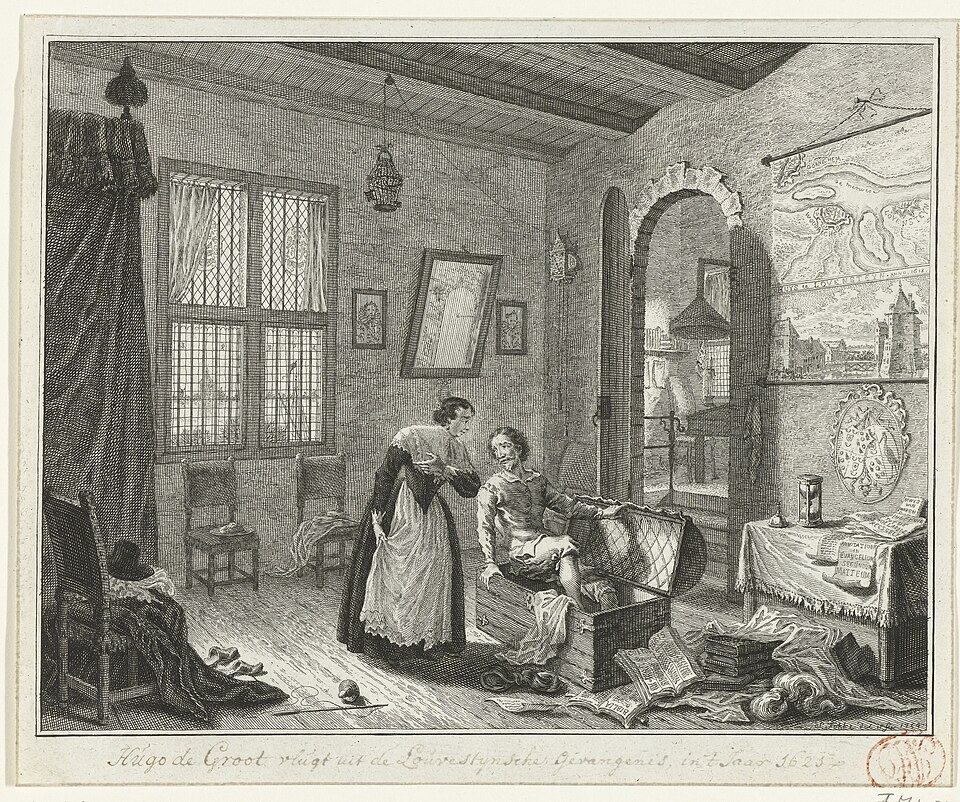
Jan Wagenaar. Hugo de Groot vlugt uit de Loevesteinsche gevangenis 1621. (Hugo Grotius Escapes the Loevenstein Prison, 1621.) Print, 1754.

Hugo Grotius, born in Delft, the Netherlands, (1583-1645) was an intellectual prodigy, who graduated from the University of Leiden at the age of fourteen.  After holding various municipal posts, he was arrested for treason in 1618 and given a life sentence in Loevenstein Castle.  Here he regularly received a large crate of books for him to read while imprisoned, and his love of books eventually led to his own freedom. In 1621, his wife and her maid managed to fit him [he was a small man] into one of these book crates and it was shipped out of the castle to France,2 where Grotius spent the rest of his life in exile. 


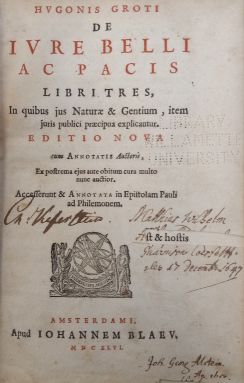
Title Page of De Iure Belli ac Pacis,
7th Ed., 1646.

Hugo Grotius is considered to be the father of International Law.  While living in France Grotius penned his most famous work, De iure belli ac pacis (On the Law of War and Peace), which was published in 1625 during the Thirty Years War (1618-1648).  This work was Grotius’ response to “the ‘licentiousness’ of Europe’s Christian rulers in rushing to war for frivolous or imprudent reasons’… Grotius worked to lay a foundation of natural law on which the law of nations and its accompanying laws of war could be built.”  The result is this three volume book.

An article from the November 20, 1897 issue of the Oregon Daily Statesman tells the story of how Willamette University received a copy of this work that now resides in the vault of the Mark O. Hatfield Library.  A copy of this article was cut out and glued to the back inside cover of that book, and it shows the book owner’s bibliophilia:

“The Seventeenth Century Hands Down One of Its Literary Gems to a Prominent Salemite.” 

“Perhaps it would not do to class President W.C. Hawley, of the Willamette University, a bibliomaniac, but that he is a bibliophile will scarcely be denied by any one cognizant of the professor’s love for books; the rarer the book the nearer he approaches the condition besetting the former devotee.

The last volume to cast the spell of its charm, born of antiquity and rare literary quality, upon this accomplished student, was one that crossed his path in Denver, Colorado, during his late visit there as a member of the head camp of the Woodmen of the World.


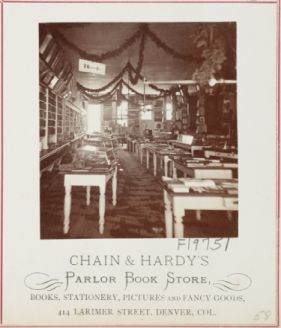
“Chain & Hardy’s
Parlor Book Store.”
1869-1879.
Denver Public Library. 4

Prof. Hawley was never known to go deliberately by an “old book” stand without stopping, and that he should bring up in front of Chain & Hardy’s stalls in that city, in one of his idle hours, needs no accounting for, but that he did so, is a matter of supreme gratification for him by reason thereof, he is the possessor of a copy of Hugo Grotius’ work on “International Law,” a treatise in Latin, that bears the same relation to the particular phase of jurisprudence that the first edition of Blackstone bore to English law. …

It is the star of his collection, and was aired here yesterday for the first time when he took it to his class in international law at the university, and unfolded its rare contents to the interested and delighted young people who have the good fortune to sit under him as pupils.”5


Bookplate in Mark O. Hatfield Library’s copy of
Hugo Grotius De Iure Belli et Pacis 1646.

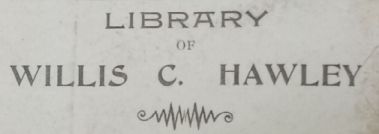
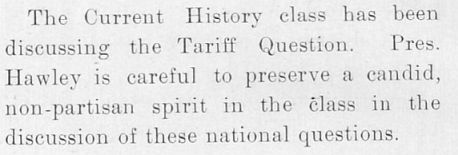
The owner of this book was Willis C. Hawley, President of Willamette University from 1893-1902.  In 1897 Hawley was a professor of Political History, Economics, and Political Science, and while at Willamette he studied Law, became a member of the Oregon State Bar and expert on tariff and tax law. The April 1895 edition of The Willamette Collegian describes how Hawley shared his expertise on tariffs with his students:


The Willamette Collegian. Vol. VI, No. 7, April 1895. 6

And the 1897 Willamette University catalog lists the textbooks that professors required for their courses.7  One of the texts that Professor Hawley frequently used in his courses was The Tariff History of the United Statesby Frank William Taussig. 8


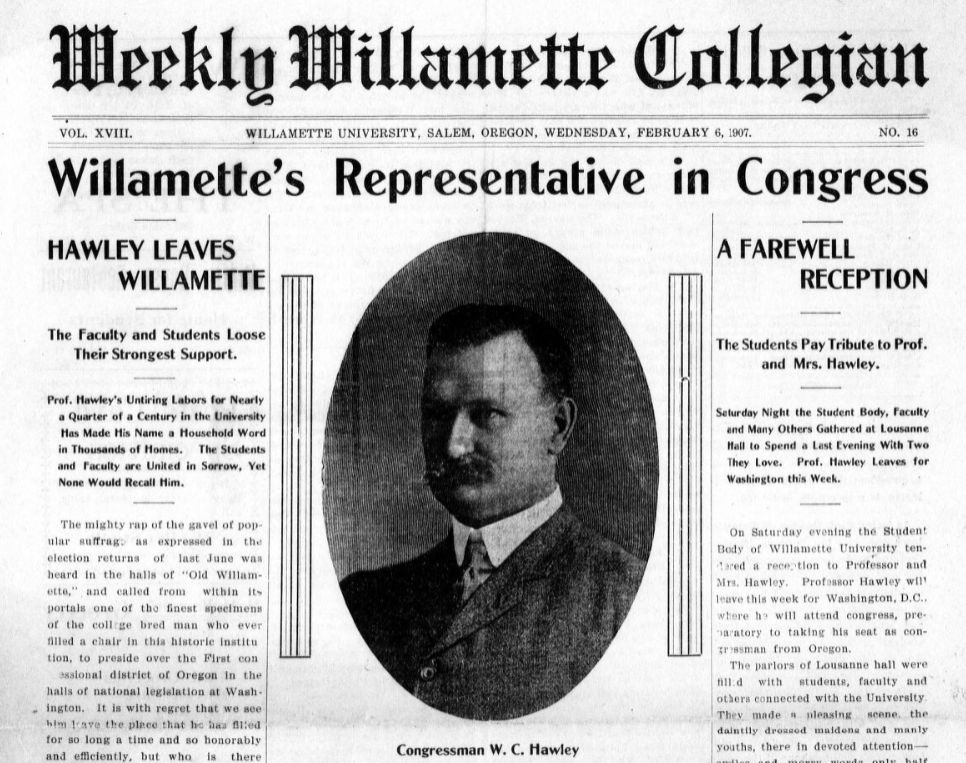
“Willamette’s Representative in Congress.” Weekly Willamette Collegian, Vol. XVIII, No 16. Feb. 6, 1907. 9

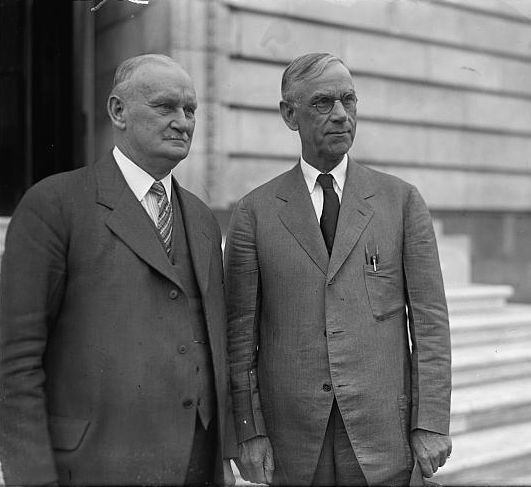
In 1902, Hawley stepped down as President of Willamette University to prepare for a campaign to run for a seat in the U.S. House of Representatives.  He served in Washington, D.C. as the Representative Oregon’s 1st Congressional District as a Republican from 1907 to 1933, and is best known for introducing legislation, along with Senator Reed Smoot of Utah, that called for raising tariffs. 10


Rep. W.C. Hawley, Reed Smoot, 4/11/29. , 1929 11

The Smoot-Hawley Tariff Act was legislation that increased average import tariffs by approximately 20 percent in an attempt to protect American farmers and businesses from foreign competition during the agricultural crisis of the late 1920s…. Some historians believe that the tariff was so high that it elicited foreign economic retaliation against the United States and helped convert what would have been a normal economic downturn in the U.S. economy into a major worldwide depression.” 12

To learn more watch this short video: Trade Wars: A Look at the Smoot-Hawley Tariff 13

Both Hugo Grotius and Willis C. Hawley loved books, but they are best remembered for their political writings and activities.  Currently the headlines are filled with news about wars challenging International Law and new Trade Wars created by tariffs, issues that Grotius’ and Hawley’s words and experiences could help us to find some solutions. That Hawley owned a rare copy of Grotius’ major work and then donated it to the Willamette University Library is a happy coincidence.  If you would like to see this book for yourself, please contact Doreen Simonsen, dsimonse@willamette.edu to make an appointment

Endnotes:

1. Cleary, Matthew, Edward Jones Corredera, Pablo Nicolas Dufour, Jonathan Nathan, Emanuele Salerno, and Mark Somos. “Hugo Grotius’s De Iure Belli ac Pacis: A Report on the Worldwide Census of the Seventh Edition (1646).” Grotiana 44, no. 1 (2023): 154-180.

2. Kingma, Marja, “Two Women, a Lawyer and a Book Chest” British Library European Studies Blog.  19 April 2021.  https://blogs.bl.uk/european/2021/04/two-women-a-lawyer-and-a-book-chest.html.

3. Devetak, Richard. “Grotius, Hugo.” In The Oxford International Encyclopedia of Peace. : Oxford University Press, 2010. https://www.oxfordreference.com/view/10.1093/acref/9780195334685.001.0001/acref-9780195334685-e-296.

4. Duhem Brothers. “Chain & Hardy’s Parlor Book Store, Books, Stationery, Pictures, and Fancy Goods, 414 Larimer Street, Denver, Col.” Denver Public Library Special Collections, x-18530, https://digital.denverlibrary.org/nodes/view/1059480

5.“The Seventeenth Century Hands Down One of Its Literary Gems to a Prominent Salemite.”  Oregon Daily Statesman. Saturday, November 20, 1897.

6. Local and Personal” The Willamette Collegian. Vol. VI, No. 7, April 1895, p. 12.

7. Fifty-Fourth Year Book of the Willamette University for the Year 1897-8 with Announcement and Curricula for 1898-9: pp. 45-46.

8. Taussig, F. W. (Frank William). The Tariff History of the United States : A Series of Essays. New York ; G.P. Putnam’s Sons, 1888.

9. “Willamette’s Representative in Congress: Hawley Leaves Willamette.” Weekly Willamette Collegian, Vol. XVIII, No 16. February 6, 1907.

10. Carlson, Luke. ” Willis Hawley (1864-1941).” The Oregon Encyclopedia. https://www.oregonencyclopedia.org/articles/hawley_willis/. Accessed May 2, 2025.

11. Rep. W.C. Hawley, Reed Smoot, 4/11/29. , 1929. Photograph. https://www.loc.gov/item/2016843632/

12. “Smoot-Hawley Tariff Act (1930).” In Gale Encyclopedia of U.S. Economic History, 2nd ed., edited by Thomas Riggs, 1219. Vol. 3. Farmington Hills, MI: Gale, 2015. Gale In Context: U.S. History (accessed May 2, 2025). https://link.gale.com/apps/doc/CX3611000828/UHIC?u=s8887317&sid=summon&xid=b6439b7e.

13. “Trade Wars: A Look at the Smoot-Hawley Tariff,” posted on June 18, 2019, by CFR Education, YouTube, 4 min., 29 sec., https://www.youtube.com/watch?v=C4CvLu8HA7I

See Also:

Grotius, Hugo. Hvgonis Grotii De ivre belli ac pacis libri tres, in quibus jus naturæ & gentium, item juris publici præcipua explicantur. Editio nova cum annotatis auctoris, ex postrema ejus ante obitum cura multo nunc auctior. Accesserunt & annotata in Epistolam Pauli ad Philemonem. Amsterdami: apud Iohannem Blaev, 1646.

Grotius, Hugo. The Rights of War and Peace. Indianapolis, IN: Liberty Fund, Incorporated, 2005. Accessed May 1, 2025. ProQuest Ebook Central.


Heritage Celebration

cherry blossom branch and three ceramic vasesMay is Asian American, Native Hawaiian, and Pacific Islander Heritage Month (also known as Asian Pacific American Heritage Month), which provides us with a great opportunity to celebrate the amazing heritage and history of people from these areas.  Now is the perfect time to reflect on the traditions, languages, and contributions of the Asian American, Native Hawaiian, and Pacific Islanders (AANHPIs).  The vibrant and varied cultures of AANHPIs have enriched America’s history and culture in so many ways.  Their impressive achievements in science, art, literature, music, dance, sports, agricultural practices, cuisine, and countless other areas, deserve recognition and appreciation. At the same time, it is also important to acknowledge the struggles and hardships experienced by AANHPIs both in the past and the present. Let’s take time this month to pay tribute to the many achievements and contributions of Asian American, Native Hawaiian, and Pacific Islanders everywhere. Check out a selection of recent materials by or about AANHPIs available from the University Libraries and listed on our WU Reads Reading Guide.

 

For more information, see:

https://asianpacificheritage.gov/

https://fapac.org/AAPI-Resources


Passionate about Poetry

cup of tea, flowers, open books of poetryIn the immortal words of Robert Frost, “Poetry is when an emotion has found its thought and the thought has found words.”  Do you love a good haiku?  How about a Shakespearean sonnet? Perhaps free verse is more to your liking?  Or maybe you prefer that old crowd favorite, a lyrical limerick?  If poetry brings you solace, or inspiration, or just plain makes you happy, this is the month for you!  That’s right, April is National Poetry Month!  Established in 1996 by the Academy of American Poets, National Poetry Month gives us the chance to celebrate poetry and poets’ vital place in American culture.  Join us in celebrating the wonder of poetry by revisiting your favorite poet or poem.  Alternatively, check out one of these books of poetry or poetry-related titles available from the University Libraries and listed on our WU Reads Reading Guide.
 

“If I feel physically as if the top of my head were taken off, I know that is poetry.”–Emily Dickinson

“Poetry is what in a poem makes you laugh, cry, prickle, be silent, makes your toenails twinkle, makes you want to do this or that or nothing, makes you know that you are alone in the unknown world, that your bliss and suffering is forever shared and forever all your own.”–Dylan Thomas


Introducing WUpedia

Did you know?

  • How the Bearcat became the mascot of Willamette University?
  • Which WU president lost his contract renewal due to tobacco use?
  • That the Quad was once an athletic field, and the theater building used to be a gymnasium?
  • A Freshman class challenge in 1909 sparked an annual Glee competition that lasted nearly 90 years?

WU Archives is excited to announce the launch of WUpedia, an online encyclopedia dedicated to exploring the people, organizations, places, events, and history of Willamette University. The site showcases student-written entries, with fresh content added each semester. Stay tuned as we continue to grow this resource, preserving and sharing fun stories, fascinating people, memorable events, and quirky campus history!


Spring Has Sprung!

pink hyacinth flower on open bookThe days are getting longer, early flowers are emerging in all their glorious colors, birds are excitedly chasing earthworms, the weather vacillates from sunny to rainy in mere seconds, and outdoor markets are starting to reopen everywhere.  It’s beginning to look a lot like springtime in the Willamette Valley!  March ushers in the official beginning of spring and offers a whole host of things for us to celebrate such as St Patrick’s Day, March Madness, and of course, who can forget Spring Break?  If you enjoy wildly unpredictable weather, green grass, baby ducklings, and blooming flora such as daffodils, crocuses, tulips, and daphne, this is the season for you!  So get on out there and chase a few rainbows and while you’re at it, check out one of these spring-related titles available from the University Libraries and listed on our WU Reads Reading Guide.
 

“Spring work is going on with joyful enthusiasm.” – John Muir
“Keep your face to the sunshine and you cannot see a shadow.” – Helen Keller


Friend Indeed

red heart paperweight holding open a bookWith Valentine’s Day as its central holiday, February is famous for love.  February is also National Library Lover’s Month so “love is in the air” no matter where you look!  There are lots of wonderful sentiments and song lyrics that celebrate love such as “love conquers all,” “love makes the world go ‘round,” and “all you need is love.”  The emphasis can often seem to be on romantic love but the love we feel for a good friend is just as important and deserves to be celebrated as well.  So if we think about love and friendship together there is one saying that seems to incapsulate Valentine’s Day and Library Lover’s Month quite nicely: “If you have a book, you have a friend.”  This month, we’re paying tribute to love in all its forms whether romantic, platonic, familial, or the love of a good book!  Check out one of these love/friendship-related titles available from the University Libraries and listed on our WU Reads Reading Guide.


Food, Glorious Food


bowls of food on a table The winter months seem to be filled with one holiday after another–Winter Solstice, Christmas, Kwanzaa, Hanukkah, New Year’s…  Many of these cultural and/or religious holidays bring together family and friends and whenever people gather, there is usually a meal involved.  When you talk to people about holiday traditions, it seems like food inevitably comes up.  Whether it’s green bean casseroles, black-eyed peas, or matzah balls, everyone has a list of foods they associate with different celebrations.  Many of these foods have deep meaning and significance to the celebrants but also, the breaking of bread together is just a wonderful way of building community and fellowship.  So gather with your people, celebrate the holidays of your choice, eat good food, and maybe just for fun, check out one of these food-related titles available from the University Libraries and listed on our WU Reads Reading Guide.


Winter is the time for comfort, for good food and warmth, for the touch of a friendly hand and for a talk beside the fire: it is the time for home. –Edith Sitwell


Page 1 of 6
1 2 3 6